The Navigators level fosters a well-rounded learning environment where students explore core subjects and support their physical and mental well-being.
At this stage, at Apogee, they sharpen their critical thinking by analyzing, questioning, and applying knowledge in meaningful ways.
Tackling Reading Development

READING: Students engage with a wide range of texts—fiction and nonfiction—analyzing themes, characters, and author intent. They learn to question the text, make predictions, and connect their reading to real-life experiences.
DEEPENING COMPREHENSION: Students explore deeper meaning through tone, symbolism, and character development. They evaluate multiple perspectives and practice expressing their ideas with clear, evidence-based reasoning.
Learning How to Write
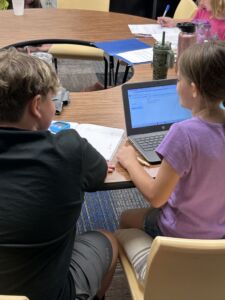
COMPLEX WRITING: Students work on various types of writing, including essays, research papers, narratives, and persuasive texts. They learn to organize their writing clearly, support their arguments with evidence, and refine their grammar and style.
CRITICAL THINKING: Writing serves as a tool for critical thinking, where Apogee students will analyze information, synthesize ideas, and present well-structured arguments. They engage in peer reviews, offering constructive feedback and improving their writing through revision.
Growing Math Ability
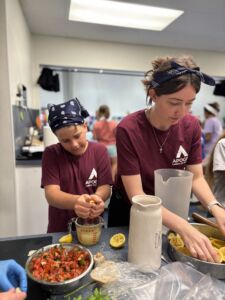 ADVANCED CONCEPTS: Students move beyond basic arithmetic to explore fractions, decimals, percentages, basic algebra, geometry, and data analysis. They focus on problem-solving, working through progressively complex word problems.
CRITICAL THINKING WITH MATH: Students think logically and critically about mathematical concepts. Instead of just memorizing formulas, they learn to understand the reasoning behind methods, recognize patterns, and apply math to real-world situations. They engage in projects that connect math to fields like science, engineering, and daily life.
Hands-On Science Projects
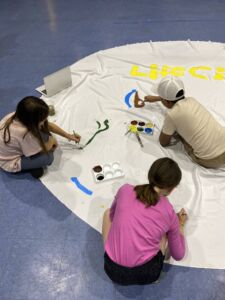
INQUIRY-BASED LEARNING: Science education encourages students to ask questions, design experiments, and analyze outcomes. Students explore topics like biology, physics, chemistry, earth science, and ecology through hands-on activities and real-world applications.
CRITICAL THINKING IN SCIENCE: Students learn the scientific method by hypothesizing, conducting experiments, and interpreting data. They also critically evaluate scientific claims, assess the credibility of sources, and consider the ethical implications of scientific advancements.
Engaging with History
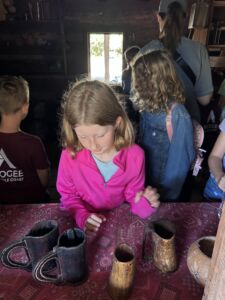
ANALYZING HISTORICAL EVENTS: Students explore various civilizations, historical events, and key figures from different time periods. They analyze the causes and effects of major historical events and evaluate multiple perspectives.
CRITICAL THINKING IN HISTORY: Students critique sources, understand bias, and explore the motivations behind historical actions. They engage in debates and discussions about historical decisions and their impact on modern society.
Developing a Healthy Lifestyle
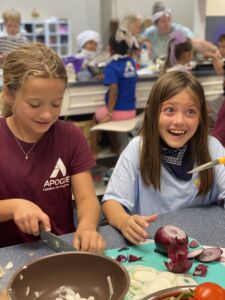
PHYSICAL HEALTH: Physical education is a key part of the curriculum, where students engage in team sports, fitness challenges, and activities that promote cardiovascular health, strength, and flexibility. They learn how exercise benefits both their bodies and minds.
MENTAL HEALTH AWARENESS: Mental health education is integrated into the curriculum, focusing on emotional regulation, self-awareness, and coping strategies. Students explore mindfulness, stress management, and how to recognize and manage their emotions. Activities like guided breathing, journaling, and group discussions are included to support mental well-being.
HEALTHY LIFE CHOICES: Students learn about the importance of nutrition, sleep, and maintaining a balanced lifestyle. They explore how good physical and mental health contribute to overall well-being and academic success. Discussions on self-esteem, social media use, and peer relationships help students build emotional resilience.
Socratic Discussion for Explorers:
Diving Deeper: As students advance, they engage in more sophisticated Socratic discussions that explore complex topics in science, history, and math. They might debate ethical questions in science or examine whether a historical event was truly fair.
Critical Analysis: Students analyze multiple viewpoints and support their ideas with evidence from their work. Math discussions may include why the Pythagorean Theorem works or how geometry applies to real-world problems.
Independent Thinking: These discussions strengthen independent thinking and problem-solving. Students learn to form and defend their opinions, listen actively, and challenge ideas with respect.
Joining Over 100 Students Enjoying Apogee Education now
Become Part of Apogee Gulf Coast to Further Your Child’s Education.